Variable Operation Decision System for Plant Protection Drones
Accurate insight, variable governance
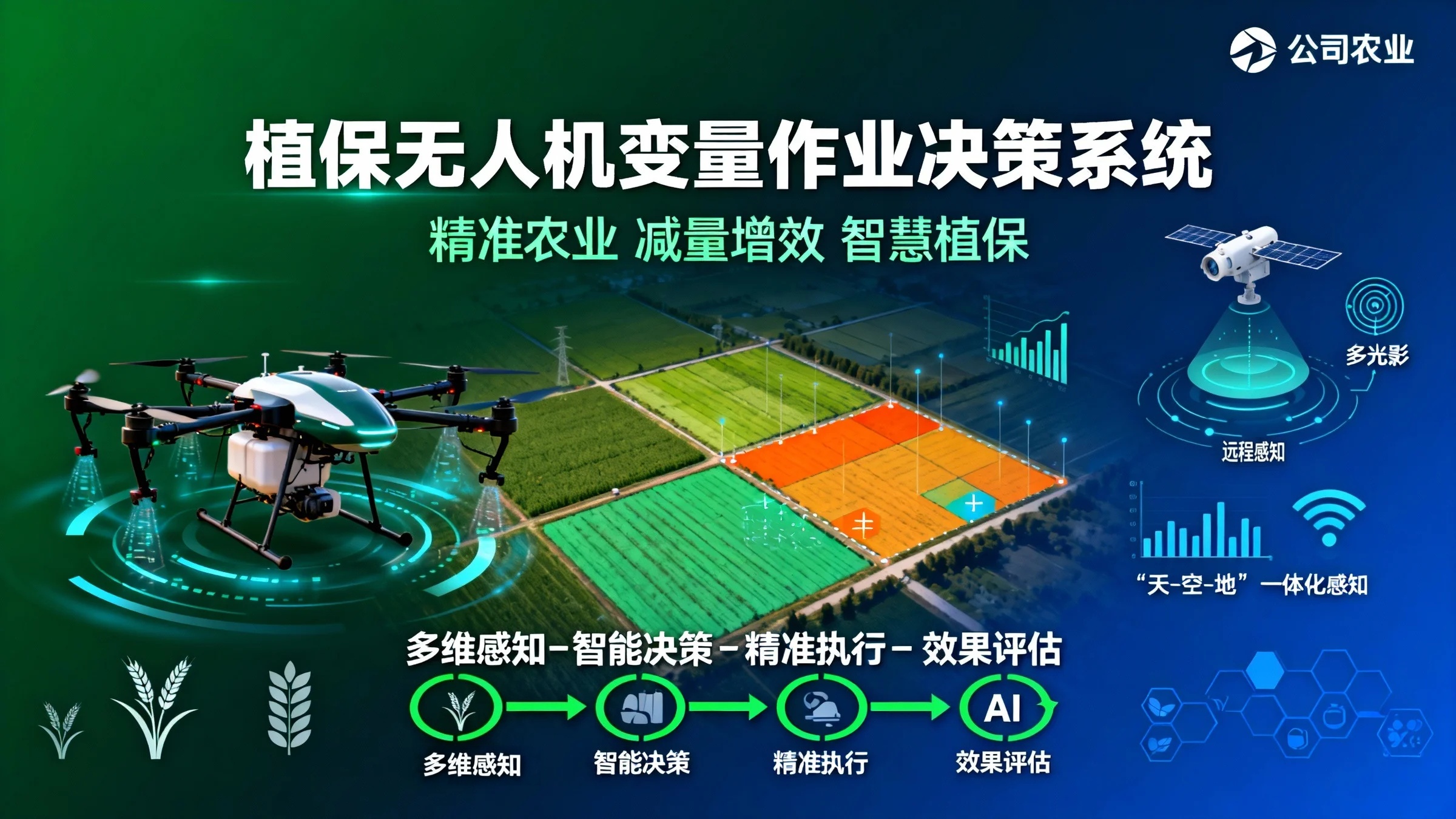
Traditional plant protection operations often suffer from the "one-size-fits-all" approach of uniform spraying, resulting in pesticide utilization rates of less than 30%. This not only leads to resource wastage and increased costs but also poses environmental pollution and food safety risks. This system achieves on-demand application and efficiency enhancement through reduction by integrating "sky-air-ground" intelligent sensing and decision-making. It elevates plant protection operations from traditional labor-intensive practices to data-driven precision agricultural services, helping large-scale agricultural operators reduce comprehensive pesticide costs by 20–35% while improving pest and disease control effectiveness by 15–25%.
I. Core System Architecture and Technical Workflow
1. Multi-Dimensional Sensing Layer: Creating a Digital Profile of Farmland
The system integrates multi-source data collection capabilities:
- Satellite Remote Sensing Monitoring: Weekly updates on crop growth, vegetation indices, and other macro-level data.
- UAV Hyperspectral/Multispectral Imaging: Captures key physiological parameters such as NDVI, chlorophyll content, and water stress with centimeter-level accuracy.
- IoT Sensor Network: Collects real-time field microclimate, soil moisture, and other environmental data.
- Historical Operation and Agricultural Database: Integrates knowledge models such as crop varieties and pest and disease occurrence patterns.
2. Intelligent Decision Engine: Generating Variable-Rate Operation Prescription Maps
The decision-making core, based on AI algorithm models, includes:
- Intelligent Pest and Disease Identification and Early Warning Model: Combines deep learning and computer vision technologies to accurately identify common pest and disease types and severity levels, achieving an accuracy rate of over 92%.
- Crop Pesticide Requirement Assessment Model: Calculates the optimal pesticide application amount based on factors such as crop growth stage, biomass, and stress levels.
- Operation Path Optimization Algorithm: Considers constraints such as wind speed, temperature, and field boundaries to generate flight paths with minimal energy consumption and optimal coverage.
- Real-Time Dynamic Adjustment Mechanism: Supports dynamic adjustment of spraying parameters during operations based on the latest monitoring data and weather changes.
3. Precision Execution Layer: Fully Autonomous Variable-Rate Operations
- Intelligent Plant Protection UAV Platform: Equipped with adjustable flow pressure nozzles and multi-channel pesticide tank systems, supporting simultaneous variable spraying of up to 8 different pesticides.
- Centimeter-Level Positioning and Terrain-Following Flight: Utilizes RTK high-precision positioning to achieve stable flight and precise spraying in complex terrains.
- Real-Time Closed-Loop Control: The flight control system adjusts flight speed, nozzle on/off, and flow rate in real time based on the prescription map, ensuring precise delivery of pesticides to target areas.
4. Effectiveness Evaluation and Optimization Loop
- Complete Operation Process Recording: Automatically generates digital operation records, including pesticide distribution, flight trajectories, and weather conditions.
- Control Effectiveness Tracking and Evaluation: Periodic aerial monitoring quantitatively assesses control effectiveness and optimizes decision-making models.
- Blockchain Traceability and Verification: Key operation data is stored on the blockchain, providing credible traceability for agricultural product quality and safety.
II. Core Advantages of the System
- Precision Diagnostic Capability
Breaks through the limitations of traditional visual and empirical judgment. Through multispectral imaging and AI analysis, early detection and quantitative assessment of pests and diseases are achieved, reducing diagnosis time by 80%. - Dynamic Prescription Generation
Generates personalized pesticide application plans based on real-time data, supporting "one field, one prescription; one zone, one strategy." Pesticide usage is reduced by 15–40% compared to traditional methods. - End-to-End Automation
Achieves complete closed-loop automation from data collection to operation execution. A single UAV can cover 800–1,200 mu per day, 30–50 times more efficient than traditional manual operations. - Data-Driven Optimization
Builds an evolving farmland knowledge graph and continuously optimizes decision-making models through machine learning, making the system increasingly intelligent.
III. Typical Application Scenarios and Benefit Analysis
Scenario 1: Precision Control of Rice Blast Disease
- Traditional Method: Uniform spraying across the entire field, high pesticide usage, and unstable control effectiveness.
- System Solution: Identifies disease hotspots through multispectral imaging and applies intensified spraying only to high-risk areas (typically 10–30% of the field).
- Quantifiable Benefits: Reduces pesticide usage by 35%, improves control effectiveness by 22%, and lowers the cost per mu by 28 yuan.
Scenario 2: Zoned Pest Management in Orchards
- Challenge: Complex orchard terrain, uneven tree canopy heights, and uneven distribution of pests and diseases.
- System Solution: Generates differentiated pesticide application plans for different areas and canopy heights through 3D modeling and canopy analysis.
- Quantifiable Benefits: Improves pesticide penetration by 40% and increases underside leaf coverage from less than 60% to over 85%.
Scenario 3: Large-Scale Farm Plant Protection托管 Services
- Business Model: Provides full托管 services, including monitoring, decision-making, operation, and evaluation, for farms larger than 10,000 mu.
- Value Proposition: Reduces direct costs through precise pesticide application, improves management efficiency by reducing labor, and enhances decision-making capabilities through data services.
- Customer Benefits: Reduces comprehensive plant protection costs by 25%, cuts management personnel by 60%, and increases yield by 5–8%.
IV. Investment Return Analysis
Taking a 3,000-mu grain production base as an example:
- Initial Investment: System deployment and equipment investment of approximately 150,000–250,000 yuan.
- Annual Savings: Reduces pesticide costs by 80,000–120,000 yuan and labor costs by 40,000–60,000 yuan.
- Increased Revenue: Improves yield through precision management, generating additional revenue of 60,000–100,000 yuan.
- Payback Period: 1.5–2.5 years, with sustained net profits generated annually thereafter.
V. Deployment and Service Support
- Modular Implementation Plan
Offers阶梯式 implementation plans, from basic sensing modules to full-system deployment, based on the client’s existing infrastructure. - Professional Agronomy Support Team
Equipped with plant protection experts, data agronomists, and UAV operation engineers to provide全程 crop management consulting. - Seasonal Operation and Maintenance Support
Provides 7×24 technical support and on-site保障 services during critical agricultural periods. - Continuous Algorithm Upgrades
Updates pest and disease identification models and decision-making algorithms quarterly based on operational data from different regions across the country.
This system is not merely a technological tool but a core engine driving the transformation of agricultural production methods. By shifting plant protection operations from "relying on experience" to "relying on data," and upgrading from "treating existing problems" to "preventing potential issues," it ultimately achieves the sustainable development goals of "improving quality, enhancing efficiency, reducing costs, and minimizing pollution" in agricultural production. It equips modern agriculture with a "intelligence brain."